Comprehensive Eye Examinations for Early Detection of Vision Disorders
Discover with Dr. Khalil Hijazi the most important comprehensive eye examinations for early detection of vision disorders and maintaining long-term eye health.
Eye health is an essential part of overall health, yet some vision disorders may develop gradually without obvious symptoms. A comprehensive eye examination can help identify changes before they significantly affect vision and can provide a broader assessment than a standard visual acuity test alone.
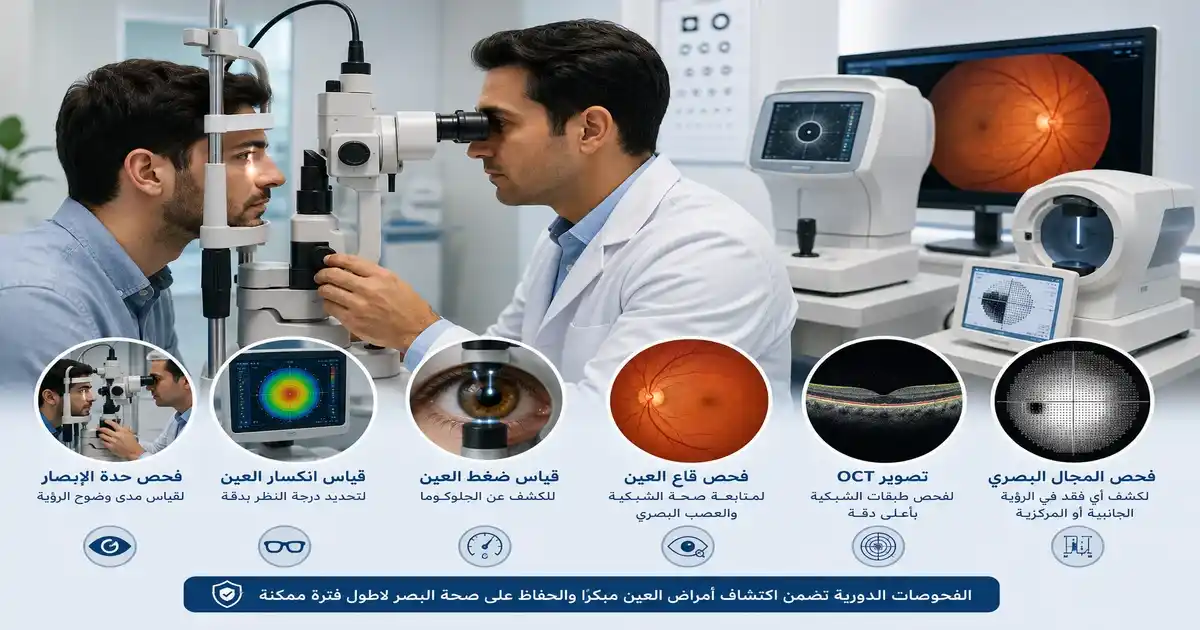
A comprehensive eye examination may evaluate visual acuity, refractive errors, intraocular pressure, the front structures of the eye, the retina, and the optic nerve. Depending on age, medical history, symptoms, and risk factors, additional tests may be recommended to provide a more detailed assessment.
At Dr. Khalil Ibrahim Hijazi Consultant & Ophthalmic Surgeon, eye examinations are approached as an important part of preventive eye care rather than simply a way to determine whether someone needs glasses. Each patient can receive an assessment tailored to their individual needs and risk factors.
Comprehensive Eye Examination and Its Importance in Early Detection of Vision Disorders
A comprehensive eye examination is not limited to reading letters from a vision chart. It may include several tests designed to assess different parts of the eye and identify changes that may not be apparent during everyday activities.
The importance of comprehensive eye examinations lies in their ability to identify certain problems at an early stage. This can give the ophthalmologist an opportunity to monitor changes or recommend appropriate treatment before the condition becomes more advanced.
Importance of a Comprehensive Eye Examination for Maintaining Vision
The importance of an eye examination is related to both visual acuity and overall eye health. A person may see clearly while still having early changes involving intraocular pressure, the retina, or the optic nerve.
A comprehensive eye examination can assess visual acuity, refractive status, the external and internal structures of the eye, and intraocular pressure when appropriate. Retinal or optic nerve assessment may also be recommended based on individual risk.
The importance of an eye examination becomes even greater when there is a family history of eye disease, chronic health conditions that may affect vision, or a new change in visual quality.
Early Detection of Eye Diseases and Its Effect on Treatment
Early detection of eye diseases can identify changes before they reach advanced stages. In some cases, the purpose of examination is to identify risk factors and monitor them, while other conditions may require treatment or additional testing.
Early detection of eye diseases also allows the ophthalmologist to compare results over time and determine whether a condition remains stable or shows progression.
For this reason, routine eye health examinations should not be limited to patients who already have symptoms. They can form an important part of preventive vision care, especially for individuals with increased risk.
When Should a Comprehensive Vision Examination Be Performed?
The answer to when you should have an eye examination depends on age, health, symptoms, and risk factors. Children require age-appropriate assessment, while adults may need examinations based on their general health and visual changes.
A comprehensive vision examination should be considered when symptoms such as blurred vision, difficulty reading, double vision, flashes, floaters, or sudden changes in the visual field occur.
Regular examinations may also be recommended for people who have a higher risk of eye disease even when they have no symptoms. The ophthalmologist determines the appropriate follow-up interval based on the findings.
Important Comprehensive Eye Tests for Assessing Visual Health
Comprehensive eye examinations may include different tests depending on the patient's needs. Assessment may begin with visual acuity and refraction before moving to intraocular pressure and examination of the internal and external structures of the eye.
Some patients may require more specialized tests to evaluate the retina, optic nerve, or cornea. Not every patient needs every test, so the examination should be tailored to medical history and initial findings.
Eye Pressure Test for Glaucoma Screening
An eye pressure test is an important part of comprehensive eye examinations when glaucoma risk needs to be assessed. It measures intraocular pressure, but pressure alone does not always establish whether glaucoma is present.
Some patients may develop glaucoma despite pressure measurements within a normal range. Therefore, the result is interpreted alongside assessment of the optic nerve and other clinical findings.
The importance of an eye pressure test increases with age and in people with a family history of glaucoma. Additional tests may be recommended when the initial evaluation indicates a need for further assessment.
Fundus Examination and Retinal Examination
A fundus examination allows the ophthalmologist to assess internal structures such as the retina, retinal blood vessels, and optic nerve. It can help identify changes associated with certain retinal disorders and other conditions that may affect vision.
A retinal examination focuses on evaluating the health of the retina and identifying abnormalities involving blood vessels, the macula, or other retinal areas.
Specialized retinal imaging may be recommended when a more detailed evaluation is needed. These tests can provide a clearer picture of retinal health and help monitor changes over time.
Comprehensive Vision Test and Visual Acuity Measurement
A comprehensive vision test evaluates the eye's ability to see details at different distances and can help identify refractive errors such as myopia, hyperopia, and astigmatism.
The examination may involve more than reading letters or symbols. Refraction may be measured carefully and the two eyes compared, particularly when symptoms or differences in vision are present.
Visual acuity measurement is an essential component of a comprehensive vision examination, but it does not by itself determine overall eye health. A person can have good visual acuity while still having a condition that requires another type of eye examination.
Eye Examination | What Does It Detect? | Importance for Early Detection |
|---|---|---|
Visual Acuity Test | Measures clarity of vision and detects refractive errors | Helps identify myopia, hyperopia, and astigmatism |
Intraocular Pressure Measurement | Detects elevated eye pressure associated with glaucoma | Helps identify increased eye pressure and glaucoma risk early |
Slit-Lamp Examination | Evaluates the cornea, lens, iris, and other anterior eye structures | Helps detect cataracts and corneal problems |
Retinal and Fundus Examination | Evaluates the retina, optic nerve, and blood vessels | Important for early detection of diabetic retinopathy and retinal diseases |
Visual Field Test | Measures peripheral vision | Helps detect changes associated with glaucoma and optic nerve disorders |
Optical Coherence Tomography (OCT) | Provides detailed images of retinal and optic nerve layers | Detects early changes in the retina, macula, and optic nerve |
Fundus Photography | Captures detailed images of the retina and optic nerve | Helps document and monitor changes over time |
Corneal and Refraction Assessment | Evaluates corneal shape and refractive errors | Important when assessing the need for glasses, contact lenses, or laser vision correction |
Eye Diseases That Can Be Detected Through Regular Examinations
Regular eye examinations can help identify a broad range of vision and eye health problems, from refractive errors requiring correction to disorders involving the retina or optic nerve.
Each test has a specific purpose, and no single test can detect every eye disease. For this reason, ophthalmologists may combine several examinations when the patient's symptoms or risk factors justify a broader assessment.
Early Detection of Chronic Eye Diseases
Early detection of eye diseases can help monitor conditions that may progress gradually. Examples include glaucoma and certain age-related or chronic-disease-related retinal disorders.
The value of early detection of eye diseases is particularly important when the condition may initially cause few or no symptoms. Good vision does not necessarily mean that every part of the eye is healthy.
Regular eye health examinations can also create a record that allows the ophthalmologist to compare results over time, which can be particularly useful when monitoring chronic conditions or risk factors.
Retinal Examination for Monitoring Visual Health
A retinal examination evaluates the tissues responsible for receiving light and transmitting visual information to the brain. It can be particularly important when visual symptoms or risk factors are present.
A retinal examination may be recommended when a change in vision is detected, when a relevant medical history exists, or when abnormalities appear during a routine eye examination.
Regular monitoring allows previous and current results to be compared, making retinal examination a valuable tool for assessing progression and deciding on the next appropriate step.
The Role of Eye Examinations in Detecting Vision Problems
Eye examinations help identify vision problems ranging from common refractive errors to conditions that require a more detailed assessment.
A patient may experience difficulty focusing, reading, or seeing clearly at night. A comprehensive vision test can help determine whether the problem is primarily refractive or whether additional examination is needed.
This is why relying on a single test may not be sufficient. The ophthalmologist selects the appropriate comprehensive eye examinations based on symptoms, age, medical history, and initial findings.
Eye Health Examinations for Children and Adults According to Age
Eye health needs change with age, so eye examinations for children and adults may have different goals and requirements. Childhood examinations focus on identifying vision problems that could interfere with visual development, while adult examinations increasingly focus on age-related and chronic eye conditions.
Eye examinations for children and adults should not necessarily be delayed until a significant problem becomes obvious, particularly when symptoms, family history, or risk factors are present.
Eye Examination for Children to Detect Early Vision Problems
An eye examination for children can help identify problems such as reduced vision, differences in visual strength between the eyes, and other conditions that may interfere with visual development.
Children may not always be able to explain a vision problem clearly. Therefore, parental observation combined with professional assessment can be important.
Possible signs include sitting very close to objects, closing one eye while looking, difficulty focusing, frequent eye rubbing, or an obvious misalignment of the eyes.
Eye Examination for Adults and Monitoring Vision Changes
An eye examination for adults can assess visual acuity, the internal and external structures of the eye, and changes associated with aging or chronic health conditions.
A broader examination may be recommended when vision changes occur, when there is a family history of glaucoma or retinal disease, or when a medical condition may affect eye health.
Glasses or contact lenses alone should not be considered a complete eye health assessment. A change in prescription can occur while other eye changes require independent evaluation.
How Often Should a Comprehensive Eye Examination Be Performed?
There is no single schedule suitable for everyone. The frequency of a comprehensive eye examination depends on age, health, previous examination results, symptoms, and risk factors.
Some people may need annual or more frequent assessment, while others without symptoms or significant risk factors may have longer intervals.
The most important approach is to follow the schedule recommended by the ophthalmologist. If new symptoms develop, patients should not wait for the next routine appointment.
How to Prepare for Comprehensive Eye Examinations
Most comprehensive eye examinations do not require complicated preparation. However, patients should inform the ophthalmologist about current symptoms, medications, family history of eye disease, and chronic health conditions.
Some examinations may require pupil dilation. This can temporarily increase light sensitivity and blur near vision, so patients may need to take appropriate precautions after the examination according to medical advice.
Steps of a Comprehensive Eye Examination
The steps of a comprehensive eye examination vary according to age and individual needs, but may include:
Reviewing medical history and current visual symptoms.
Measuring visual acuity and assessing refraction when appropriate.
Examining the cornea, lens, and anterior structures of the eye.
Measuring intraocular pressure when indicated.
Examining the fundus, retina, and optic nerve.
Performing imaging or additional tests when further assessment is required.
After reviewing the findings, the ophthalmologist determines whether routine follow-up, specialized testing, or treatment is appropriate.
Comprehensive Vision Test Results and How to Understand Them
Comprehensive vision test results provide information about visual acuity and the parts of the eye examined during the assessment. Results may indicate a refractive error, normal findings in certain structures, or changes requiring additional evaluation.
A single result should not be interpreted separately from the rest of the examination. For example, visual acuity may be good while intraocular pressure or retinal findings indicate a need for further assessment.
The ophthalmologist explains the results and determines whether the patient needs glasses, monitoring, or additional testing. Comparing results from different visits can also help identify changes over time.
Choosing the Best Eye Tests for Early Detection
The best eye tests for early detection depend on age, symptoms, health conditions, family history, and findings from the initial assessment. There is therefore no universal test package that suits every patient.
A visual acuity test may be sufficient to identify a refractive error in one person, while another may need eye pressure measurement, fundus examination, retinal assessment, or specialized imaging.
When considering the best eye tests for early detection, the focus should be on appropriate and comprehensive assessment rather than simply the number of tests. The most useful examination is the one that answers the relevant clinical questions about the patient's eye health.
Conclusion
A comprehensive eye examination is an important tool for maintaining visual health because it goes beyond measuring vision or determining whether glasses are required. It can help identify changes in intraocular pressure, the retina, optic nerve, and other eye structures before significant symptoms appear.
The comprehensive eye examinations required vary according to age, health, symptoms, and risk factors. They may include a comprehensive vision test, eye pressure assessment, fundus examination, retinal examination, and additional specialized tests when needed.
At Dr. Khalil Ibrahim Hijazi Consultant & Ophthalmic Surgeon, Dr. Khalil Ibrahim Hijazi focuses on individualized eye assessment, early detection, and appropriate follow-up to support long-term visual health.
With Dr. Khalil Hijazi, regular eye monitoring can become a practical step toward identifying changes early and protecting eye health and visual quality.
Frequently Asked Questions
Related Articles
When Do You Need a Comprehensive Eye Exam Without Symptoms?
Protect your vision with Dr. Khalil! Learn when you need a comprehensive eye exam without symptoms and how early detection can help preserve healthy vision.
Eye Pressure Measurement: Why It Is Essential for Glaucoma Detection
Eye pressure measurement is an important part of glaucoma assessment. Dr. Khalil helps evaluate eye pressure and related risk factors to support early detection and vision protection.
Fundus Imaging: When Is It Recommended and Why Is It Important?
Explore fundus imaging with Dr. Khalil to understand its importance, indications, and role in detecting retinal changes and monitoring long-term eye health.
Retinal Tear: How Is It Diagnosed and Treated Before Vision Loss?
A retinal tear may cause sudden floaters or flashes and requires timely diagnosis and appropriate treatment before it progresses to retinal detachment and vision loss.