First Aid for Eye Injuries and When the Condition Becomes an Emergency
Discover with Dr. Khalil Hijazi the Eye Injury First Aid and Emergency Signs and when rapid medical assessment is important to protect vision.
Eye injuries require careful and timely management because some minor injuries may improve quickly, while others can threaten vision if treatment is delayed. Common eye injuries can result from dust, foreign bodies, scratches, blunt trauma, chemicals, workplace accidents, or everyday activities.
Knowing Eye Injury First Aid and Emergency Signs can help prevent additional damage before medical evaluation, but home measures should not replace professional assessment when warning signs appear. Chemical exposure, penetrating injuries, high-speed impacts, and sudden changes in vision require particular attention.
At Dr. Khalil Ibrahim Hijazi Consultant & Ophthalmic Surgeon, eye injuries are assessed according to their mechanism, severity, and effect on vision. The purpose is to identify whether urgent treatment or monitoring is needed and to protect the health of the eye.
First Aid for Common Eye Injuries and How to Handle Them
First aid for the eye depends on the type of injury. Dust or small particles may often be removed by gentle irrigation with clean water, while penetrating injuries and embedded objects require a completely different approach.
The basic rule is to avoid rubbing or pressing on the eye after an injury. Rubbing can worsen a corneal scratch or move a foreign object. Contact lenses should also be removed and avoided until the eye has recovered or has been medically assessed.
First Aid for the Eye When a Foreign Body Enters
When dust or a small loose particle enters the eye, wash your hands first and gently rinse the eye with clean water. Blinking repeatedly may help remove a small particle, but rubbing should be avoided.
If the object does not come out easily, appears embedded, or is associated with significant pain or vision changes, do not use tweezers, cotton swabs, or other instruments to remove it.
High-speed objects, such as metal fragments produced while using power tools, can cause deeper injuries even when the external wound looks small. These cases require prompt medical assessment.
Treatment of Corneal Scratches and Minor Injuries
A corneal scratch may result from dust, fingernails, contact lenses, or contact with a small object. Symptoms can include pain, tearing, redness, a gritty sensation, blurred vision, and light sensitivity.
Treatment of corneal scratches should not be based on random home remedies because an examination may be needed to exclude a retained foreign body, infection, or deeper injury.
Initial care may include rinsing the eye with clean water and avoiding rubbing. Contact lenses should not be worn while the eye is injured.
Persistent pain, redness, blurred vision, or light sensitivity should prompt an eye examination because untreated corneal abrasions can become infected.
How to Clean an Injured Eye Correctly
How to clean an injured eye depends on the cause. If dust or a loose small particle is involved, the eye can be gently rinsed with clean water while keeping the eyelids open.
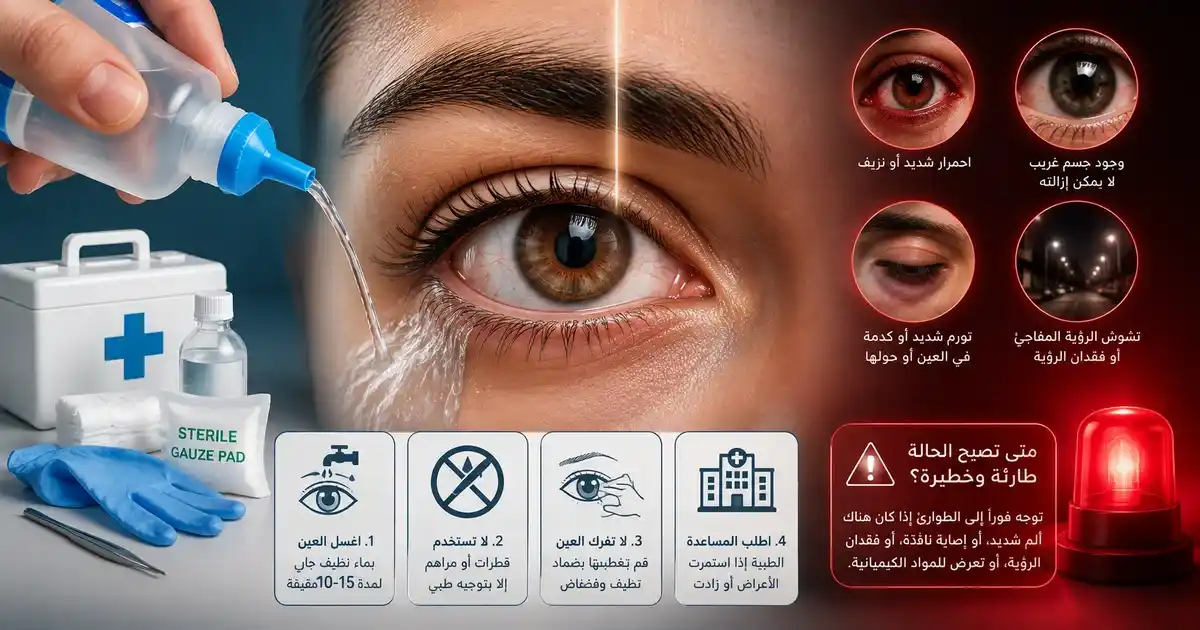
Strong water pressure should be avoided, as should rubbing the eye or inserting objects into it. If a chemical has entered the eye, immediate and continuous irrigation becomes a critical first-aid measure and should not be delayed until medical care is reached.
If a sharp object has penetrated the eye or is embedded in it, do not attempt to remove it. The eye should be protected without pressure while urgent medical care is arranged.
Emergency Eye Injuries That Need Rapid Medical Attention
Some eye emergencies require rapid assessment even when the initial pain is not severe. These include penetrating injuries, high-speed impacts, sudden vision changes, severe eye pain, inability to open or move the eye, and blood or discharge coming from the eye.
Chemical eye injuries are particularly time-sensitive because prolonged exposure can increase tissue damage. Immediate irrigation should therefore begin as soon as possible, followed by professional assessment.
Symptoms of a Serious Eye Injury
Certain signs suggest that an injury may be more than a minor surface problem. Serious eye injury symptoms can include:
Sudden or reduced vision, severe or worsening pain, marked light sensitivity, inability to open or move the eye normally, significant bleeding, fluid or discharge from the eye, or a sharp object that has penetrated the eye.
High-speed injuries, such as metal fragments from power tools, also require prompt assessment even when the visible wound appears limited. Internal damage cannot always be judged from the external appearance of the eye.
Chemical Eye Injury and How to Respond
A chemical eye injury is one of the situations that requires immediate action. If a chemical enters the eye, begin flushing it immediately with a large amount of clean water while keeping the eye open as much as possible. Continue irrigation while seeking medical assistance.
Do not attempt to neutralize the chemical with another substance because this may create an additional reaction and cause further damage. If contact lenses can be removed easily without delaying irrigation, they should be removed.
If possible, bring the chemical container or product information for the medical team. However, do not delay irrigation while trying to identify or locate the product. Rapid removal of the chemical is a key part of limiting injury.
Eye Bleeding After Injury and When It Becomes Serious
Bleeding around or inside the eye can occur after blunt trauma. Its significance depends on where the bleeding occurs, how extensive it is, and whether vision is affected.
Eye bleeding after injury becomes more concerning when accompanied by reduced vision, severe pain, light sensitivity, significant distortion of the eye, blood coming from the eye, or a penetrating injury.
Do not press on the injured eye or attempt to clean inside it. Any significant bleeding associated with trauma should be assessed appropriately.
Type of Eye Injury | Appropriate First Aid | When Is It an Emergency? |
|---|---|---|
Simple Foreign Body | Gently rinse the eye with clean water and avoid rubbing it | If the object does not come out or pain and blurred vision persist |
Chemical Exposure | Immediately flush the eye with plenty of water for at least 20 minutes | An emergency requiring urgent medical evaluation |
Blow or Bruising Around the Eye | Gently apply a cold compress around the eye without pressing on the eyeball | If vision decreases, severe pain occurs, or bleeding develops |
Cut or Laceration of the Eye | Do not apply pressure; loosely cover the eye without touching it | Urgent medical care is required |
Penetrating or Embedded Foreign Object | Do not attempt to remove it or press on the eye; protect the eye without touching the object | A serious emergency requiring immediate medical assessment |
Bleeding in or Around the Eye | Avoid pressure and rubbing and seek medical assessment | If significant bleeding or vision changes occur |
Sudden Vision Loss or Decrease | Avoid driving and seek urgent medical care | An emergency requiring immediate examination |
Severe or Persistent Pain After Injury | Do not use eye drops or medications without medical advice | May indicate a serious injury and requires urgent evaluation |
When Is an Eye Injury an Emergency and Potentially Dangerous?
Some eye injuries require rapid medical treatment to reduce the risk of permanent visual damage. Severity should not be judged by pain alone because some significant injuries may initially produce limited symptoms.
Particular caution is needed with chemical injuries, sharp penetrating objects, high-speed impacts, and any trauma associated with changes in vision. Children also require careful assessment when the mechanism of injury is unclear or symptoms persist.
Signs That Require Immediate Eye Examination
Several warning signs make urgent medical evaluation especially important. These include:
Changes in vision after injury, severe pain, strong light sensitivity, bleeding, inability to open the eye, difficulty moving it normally, an embedded object, or blood or discharge coming from the eye.
Medical assessment is also recommended when symptoms persist after a seemingly minor foreign body injury or when the eye does not improve as expected.
Eye Emergencies Caused by Accidents
Eye emergencies can occur after falls, household accidents, sports injuries, workplace incidents, metal fragments, or chemical exposure. The risk of serious injury increases when an object strikes the eye at high speed or penetrates the eye.
In these situations, patients should not simply wait to see whether symptoms disappear, particularly if pain or vision changes are present.
If vision is affected, the injured person should avoid driving themselves to medical care and should arrange appropriate transportation.
Risks of Delaying Treatment for Eye Injuries
Delayed treatment can increase the risk of infection, persistent inflammation, worsening corneal injury, and, in deeper trauma, damage to internal eye structures.
Speed is particularly important in chemical eye injuries because reducing the duration of chemical contact can limit tissue damage. Penetrating wounds and intraocular foreign bodies also require specialist evaluation to determine the extent of injury and appropriate treatment.
For this reason, clearly serious injuries should not be managed at home while waiting for symptoms to worsen.
Ways to Protect the Eyes From Daily Injuries and Accidents
Preventing eye injuries starts with recognizing hazards at home, at work, and during sports. Many injuries can be reduced by using appropriate protective equipment, especially when working with tools, chemicals, or flying particles.
Children should also be taught not to play with sharp objects or chemicals and not to use toys or equipment that can propel small objects toward the face without suitable supervision.
Protecting the Eyes During Work and Activities
Eye injuries are more likely during drilling, cutting, welding, repairs, power-tool use, and chemical handling. Suitable protective eyewear should therefore be used according to the specific hazard.
Ordinary prescription glasses should not be assumed to provide adequate protection against every workplace risk.
During sports, protective eyewear designed for the activity can reduce the risk of traumatic injury. Chemicals should also be stored safely and away from children, with product instructions followed carefully.
Using Protective Equipment to Protect Vision
Protective equipment should be selected according to the specific risk. It may include safety glasses, face shields, or other suitable protection when working with chemicals, flying particles, or impact hazards.
Protective equipment should fit securely and be replaced if damaged. It should remain in place while the hazard is present, even during short or apparently simple tasks.
Protection cannot eliminate every injury, but it can reduce exposure to chemicals, particles, fragments, and direct impact.
Reducing the Risk of Eye Injuries in Children
Children may be more vulnerable to injuries because they may not recognize hazards. Cleaning products, chemicals, sharp tools, and other dangerous objects should therefore be kept out of their reach.
Parents should also be cautious with toys containing small parts or mechanisms that can launch objects toward the face and should teach children not to rub their eyes if dust enters them.
If a child develops significant pain, vision changes, or an inability to open the eye after an injury, medical assessment should not be delayed.
Correct Steps to Take After an Eye Injury Before Seeing a Doctor
Correct first aid can help prevent additional injury before medical evaluation. The approach should remain simple and safe, and it should depend on the nature of the injury.
In serious cases, the purpose of first aid is to protect the eye, stop further exposure, and obtain medical care rather than attempting to diagnose or treat the injury at home.
What to Do When an Eye Injury Occurs
First, move away from the source of danger and make sure the environment is safe. Then follow the appropriate steps:
Rinse the eye with clean water if loose dust or a small non-embedded particle has entered it.
Immediately and continuously rinse the eye after chemical exposure.
Avoid rubbing or pressing on the eye.
Do not attempt to remove a sharp or embedded object.
Remove contact lenses if this can be done without delaying essential first aid.
Seek urgent medical assessment when there is vision loss or change, severe pain, bleeding, or penetrating trauma.
What to Avoid After an Eye Injury
Do not rub the eye or use tweezers, cotton swabs, or other tools to remove an embedded object.
Unprescribed eye drops or household substances should not be placed in the eye, particularly when the injury is severe or unclear.
For chemical injuries, do not attempt to neutralize the chemical with another substance and do not delay irrigation while waiting for medical care. If an object has penetrated the eye, do not press on it or attempt to remove it.
Importance of Early Diagnosis of Eye Injuries
Early diagnosis helps determine whether an injury is superficial or has affected the cornea or deeper structures. Depending on the situation, the ophthalmologist may assess visual acuity, examine the cornea and ocular surface, and look for foreign bodies, bleeding, or deeper trauma.
Early evaluation becomes particularly important when symptoms persist or vision changes occur. In chemical injuries, rapid irrigation followed by medical assessment is an important part of reducing damage and protecting the eye.
Conclusion
First aid for eye injuries begins with calm, rapid action and avoiding measures that could worsen the damage. A small foreign particle may require gentle irrigation with clean water, while a chemical eye injury requires immediate and continuous irrigation. Penetrating injuries and embedded objects should never be removed at home.
Serious eye injury symptoms such as vision changes, severe pain, significant bleeding, strong light sensitivity, or inability to open the eye should be treated as warning signs requiring prompt medical care. Early diagnosis can also identify injuries that are not obvious externally and guide appropriate treatment.
At Dr. Khalil Ibrahim Hijazi Consultant & Ophthalmic Surgeon, eye injuries are assessed according to their nature and severity, with emphasis on protecting vision and maintaining eye health.
With Dr. Khalil Hijazi, timely assessment can be an important step toward protecting the eye and reducing the consequences of injuries that require specialist care.
Frequently Asked Questions
Related Articles
Sports Eye Injuries: Prevention and Immediate Treatment
Sports Eye Injuries: Prevention and Immediate Treatment explains common sports-related eye injuries, first aid, prevention, protective eyewear, and warning signs requiring medical evaluation.
Chemical Eye Burns: First Aid and Rapid Treatment
Dr. Khalil explains chemical eye burns, the immediate first-aid steps, warning signs, and treatment options that help protect the cornea and vision.
Foreign Body in the Eye: The Right Response to Prevent Complications
Discover with Dr. Khalil Hijazi how to deal safely with a foreign body in the eye, when first aid is enough, and when medical evaluation is essential.
Retinal Tear: How Is It Diagnosed and Treated Before Vision Loss?
A retinal tear may cause sudden floaters or flashes and requires timely diagnosis and appropriate treatment before it progresses to retinal detachment and vision loss.