Amblyopia in Children: Causes, Treatment, and the Importance of Early Diagnosis
Learn with Dr. Khalil Hijazi how amblyopia in children develops and why early diagnosis and appropriate treatment can help protect healthy visual development.
Vision problems during childhood deserve particular attention because normal visual development depends on both eyes providing clear and coordinated images to the brain. When vision does not develop normally in one eye or, in some cases, both eyes, a condition known as amblyopia may develop. If it is not identified and managed appropriately, it can affect visual development and the quality of vision later in life.
Amblyopia may be difficult for parents to notice because a child can often rely on the stronger eye during daily activities. The child may not realize that vision in one eye is weaker than the other. This is why routine eye examinations are important, particularly when there is a family history of amblyopia, strabismus, or significant refractive errors.
At Dr. Khalil Ibrahim Hijazi Consultant & Ophthalmic Surgeon, children are evaluated individually to identify the underlying cause and determine an appropriate treatment plan based on age, visual development, and the condition of both eyes.
Amblyopia in Children and Its Causes
Amblyopia develops when vision in one eye or both eyes does not develop normally during childhood. The brain gradually relies more heavily on the eye providing the clearer image and may reduce its response to signals from the weaker eye.
Early identification is important because the visual system is particularly adaptable during childhood. Delayed diagnosis may make visual improvement more difficult, particularly when the underlying problem has remained untreated for a long period.
Causes of Amblyopia and Their Effect on Vision
The causes of amblyopia can include refractive errors such as myopia, hyperopia, or astigmatism, especially when there is a significant difference in prescription between the two eyes. In such cases, one eye may provide a clearer image while the other sends a blurred image to the brain.
Strabismus is another important cause. When the eyes are not properly aligned, the brain may suppress the image from one eye to avoid double vision. Over time, this reduced use can interfere with normal visual development.
Less commonly, a condition that blocks or significantly reduces the clarity of the image reaching the eye during early childhood may contribute to amblyopia. This is why assessment should evaluate both visual function and the health of the eye.
Vision Problems in Children Associated with Amblyopia
Amblyopia may occur alongside several childhood vision problems, including myopia, hyperopia, astigmatism, and unequal refractive errors between the eyes.
A child may naturally rely on the stronger eye without realizing that the other eye is not seeing as clearly. As a result, the condition may remain unnoticed, particularly when there is no obvious eye misalignment.
Uncorrected vision problems may also affect school performance and activities that require sustained visual attention. A child may move closer to books or screens, have difficulty reading, lose concentration quickly, or struggle with tasks that require accurate visual judgment.
Strabismus and Amblyopia and Their Relationship to Poor Vision
Strabismus and amblyopia are related conditions but are not the same problem. Strabismus refers to misalignment of the eyes, while amblyopia describes reduced visual development in one or both eyes.
When persistent strabismus occurs during the visual development period, the brain may suppress information from the misaligned eye to avoid double vision. This can contribute to amblyopia.
Early assessment of strabismus can therefore be important for protecting visual development. However, the presence of strabismus does not automatically mean that surgery is required. Management depends on the cause, age, degree of misalignment, and vision in each eye.
Symptoms of Amblyopia and the Importance of Early Diagnosis
Amblyopia can be difficult to identify through home observation alone because a child can often use the stronger eye for most everyday activities. The child may not complain about blurred vision because they may not know that vision should be clearer.
Routine eye examinations are therefore valuable even when there are no obvious complaints. Assessment becomes particularly important when there is a family history of vision problems or when parents notice unusual visual behavior.
Symptoms of Amblyopia in Children
Symptoms of amblyopia in children can vary according to the underlying cause and severity. Possible warning signs include:
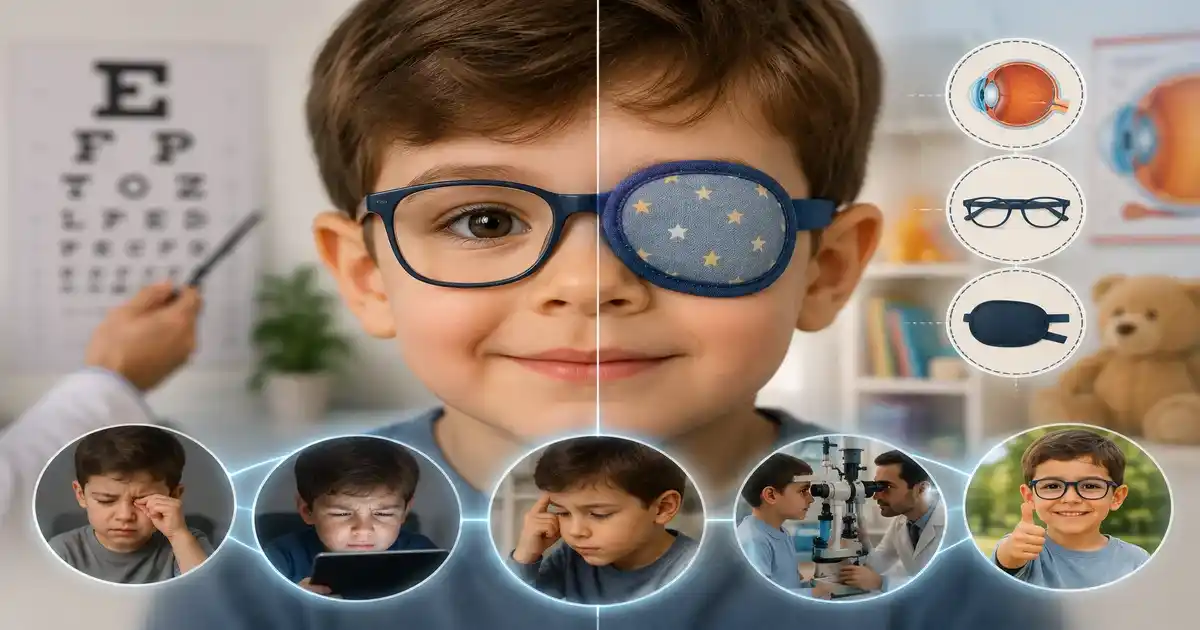
Closing one eye when looking at distant objects.
Tilting or turning the head to see more clearly.
Holding books or screens unusually close.
Difficulty judging distances or handling objects accurately.
Frequent eye rubbing or complaints of visual fatigue.
Noticeable eye misalignment or strabismus.
Difficulty concentrating while reading or doing close-up tasks.
These signs do not necessarily confirm amblyopia, but they should prompt an eye examination to determine the underlying cause.
Early Diagnosis of Amblyopia to Protect Vision
Early diagnosis of amblyopia generally involves measuring visual acuity separately in each eye, assessing refractive error, evaluating eye alignment, and examining the eye to rule out structural or medical causes.
Additional testing may be needed depending on the child's age and ability to cooperate during the examination. Identifying the weaker eye and understanding why its vision is reduced are essential steps before selecting treatment.
Early diagnosis provides a better opportunity to intervene while the visual system remains responsive to treatment. Parents should therefore avoid waiting until a child develops obvious difficulties at school or home before arranging an examination.
Factor or Cause | How Does It Affect the Eye? | Treatment and Importance of Early Diagnosis |
|---|---|---|
Strabismus | The brain may suppress the image coming from the misaligned eye | Early treatment of strabismus can help improve visual development |
Different Prescription Between the Eyes | The brain may rely on the better-seeing eye, reducing vision in the other eye | Corrective glasses and regular follow-up can help improve vision |
Severe Myopia or Hyperopia | Prolonged blurred images may interfere with normal visual development | Early correction of the refractive error can reduce the risk of persistent amblyopia |
Clouding of the Lens or Cornea | Prevents a clear image from reaching the retina | Timely treatment of the underlying cause is important to prevent permanent visual impairment |
Drooping Eyelid (Ptosis) | May block part of the visual field or interfere with normal visual stimulation | Early assessment and determining whether intervention is needed can help protect visual development |
Signs Noticed by Parents | Moving close to objects, closing one eye, or difficulty focusing may indicate a visual problem | An eye examination when these signs appear can support early diagnosis |
Patching or Glasses | Encourages the weaker eye to work more effectively | Following the treatment plan prescribed by a pediatric ophthalmologist improves the chances of recovery |
Early Examination and Follow-Up | Helps identify the cause before reduced vision becomes more established | Early diagnosis and treatment during childhood improve the chances of visual improvement |
Eye Examinations for Children and Their Role in Detecting Problems
Eye examinations for children are an important way to detect visual problems that children may not be able to describe. A comprehensive assessment can include visual acuity, eye alignment, focusing ability, refractive measurements, and examination of the eye's health.
Routine evaluation becomes especially important when risk factors are present, such as a family history of amblyopia or strabismus, significant differences in prescription, or unusual visual behavior.
Regular follow-up can also detect changes as the child grows and allows treatment to be adjusted when necessary.
Treatment of Amblyopia and Improving Vision in Children
Amblyopia treatment depends on the underlying cause, the child's age, the severity of reduced vision, and the condition of the other eye. There is no single treatment that is appropriate for every child.
Treatment may begin with correcting refractive errors using glasses. Additional measures may then be introduced to encourage the weaker eye to become more active, depending on the individual case.
Medical Treatment of Amblyopia
Treatment usually begins by correcting the factor responsible for reduced visual development. If a child has myopia, hyperopia, or astigmatism, appropriately prescribed glasses may be an essential part of treatment.
In selected cases, the doctor may recommend covering the stronger eye for a specific period to encourage the brain to use the weaker eye. Certain eye drops may also be considered in appropriate situations to reduce reliance on the stronger eye.
The duration and intensity of treatment depend on age, severity, and response. Parents should therefore avoid changing the treatment schedule without medical guidance.
Amblyopia Exercises and Their Role in Treatment
The term amblyopia exercises may refer to specific visual activities recommended according to a child's condition. Their usefulness depends on the cause and type of visual problem and they should not be considered a universal substitute for glasses, patching, or medical treatment when these are indicated.
Some activities may be useful as part of a structured treatment program, particularly when visual coordination or specific aspects of visual function need attention. However, exercises should be guided by a professional assessment.
The most important principle is to follow the prescribed treatment plan and monitor vision in each eye rather than relying on generalized exercises without a diagnosis.
Treatment of Poor Vision in Children
Treatment of poor vision in children depends on its underlying cause. A child may need glasses, amblyopia treatment, strabismus management, or assessment for another condition affecting the clarity of the image reaching the brain.
Glasses should be appropriately prescribed and worn according to medical instructions. Follow-up is important because refractive measurements can change as children grow.
The goal is not only to improve vision in the short term but also to support normal visual development and reduce the likelihood of persistent visual impairment.
Ways to Prevent Amblyopia and Its Complications
Not all cases of amblyopia can be prevented because some may be associated with genetic factors or conditions that develop during early childhood. However, delayed diagnosis can often be avoided through appropriate eye examinations and attention to early warning signs.
The first years of life are particularly important for visual development. Detecting strabismus, refractive errors, or other conditions that reduce image clarity can provide an opportunity to begin treatment before visual development becomes more difficult to influence.
Preventing Amblyopia During Childhood
Prevention begins with monitoring a child's visual development and arranging age-appropriate examinations, particularly when signs such as strabismus, closing one eye, or difficulty seeing are present.
Parents should also follow prescribed glasses instructions and should not discontinue them simply because the child's vision appears better. Consistent correction may be an essential part of protecting visual development.
It is also important not to rely entirely on parental observation because some forms of amblyopia have few visible signs during everyday activities.
Regular Monitoring of Children's Eye Health
Regular follow-up can identify changes in vision as children grow, particularly because refractive measurements can change with age. A pediatric eye specialist may determine follow-up intervals according to the child's condition and risk factors.
Visits may include visual acuity assessment, refractive measurements, eye alignment evaluation, and assessment of the child's response to treatment when therapy is already underway.
Follow-up also allows glasses or treatment plans to be adjusted when needed.
Causes of Poor Vision in Children and Ways to Reduce Their Impact
Causes of poor vision in children can include refractive errors, strabismus, amblyopia, and certain eye conditions that affect visual development.
Not every cause can be prevented, but its impact may be reduced through early diagnosis, appropriate treatment, and regular eye examinations.
Parents should also encourage healthy visual habits, moderate screen use, regular breaks during close-up activities, and a generally healthy lifestyle that supports eye health.
Best Medical Solutions for Amblyopia Treatment
The best treatment for amblyopia differs from one child to another. Some children may respond well to correction of refractive errors, while others may require patching or additional treatment.
Early treatment does not necessarily mean using more aggressive intervention. It means identifying the cause and applying an appropriate treatment while the visual system is still responsive.
Best Treatment for Amblyopia According to the Child's Age
Age influences the management of amblyopia because the visual system's ability to develop and adapt changes throughout childhood. Earlier diagnosis generally provides a better opportunity to improve vision.
Treatment may begin with correcting refractive errors and may include patching of the stronger eye or other measures depending on the child's assessment. Continued follow-up is important to determine whether vision in the weaker eye is improving.
The best treatment cannot be determined by age alone. The cause, degree of visual impairment, and response to therapy must also be considered.
Amblyopia Surgery and When It May Be Needed
There is no single operation that directly treats amblyopia in every child. Amblyopia is usually related to abnormal visual development rather than a problem that can be corrected surgically by itself.
Some children may need surgery to treat an associated condition, such as certain forms of strabismus or another problem that prevents a clear image from reaching the eye. In these situations, surgery targets the underlying cause rather than amblyopia itself.
The decision should follow a detailed assessment by an eye specialist experienced in pediatric ophthalmology and eye surgery.
Improving Vision and Reducing the Future Impact of Amblyopia
Improving vision and reducing the long-term effect of amblyopia requires adherence to treatment and continued monitoring. Treatment should not be stopped simply because early improvement becomes noticeable.
Regular eye examinations remain important even after vision improves because refractive errors can change as children grow. Parents should report renewed eye misalignment, reading difficulties, or noticeable changes in vision.
At Dr. Khalil Eye Center, follow-up focuses on monitoring visual development and providing guidance appropriate to each stage of the child's growth.
Conclusion
Amblyopia in children is a visual development problem that deserves early recognition and appropriate management. The early years of life are particularly important because visual pathways between the eyes and brain are still developing. Amblyopia may be associated with refractive errors, strabismus, or other conditions that reduce the clarity of the image reaching the brain.
Early diagnosis provides a better opportunity to select appropriate treatment, whether through refractive correction, patching, or other measures. Some children may also require treatment of an underlying condition, including surgery when there is a specific medical indication.
At Dr. Khalil Ibrahim Hijazi Consultant & Ophthalmic Surgeon, children are assessed individually according to age, visual acuity, eye health, and the suspected cause of reduced vision.
Regular follow-up and attention to changes in a child's visual behavior remain important steps in supporting healthy visual development and reducing the future impact of amblyopia.
Frequently Asked Questions
Related Articles
Treatment of Strabismus in Children: Nonsurgical and Surgical Options
This article explains Treatment of Strabismus in Children: Nonsurgical and Surgical Options, including its causes, symptoms, diagnosis, glasses, exercises, patching, surgery, and follow-up.
Routine Eye Examinations for Children and Their Importance for Healthy Visual Development
Routine Eye Examinations for Children and Their Importance for Healthy Visual Development help detect vision problems early and support normal visual growth with specialized care from Dr. Khalil.
Persistent Tearing in Children: Causes and When Medical Care Is Needed
Persistent tearing in children may be caused by allergies, blocked tear ducts, inflammation, or eye surface problems. Early evaluation helps identify the cause and choose appropriate treatment.
Signs of Strabismus in Children and When to See an Ophthalmologist
Discover with Dr. Khalil Hijazi the signs, causes, and treatment options for childhood strabismus and the importance of early diagnosis for healthy visual development.