Treatment of Strabismus in Children: Nonsurgical and Surgical Options
This article explains Treatment of Strabismus in Children: Nonsurgical and Surgical Options, including its causes, symptoms, diagnosis, glasses, exercises, patching, surgery, and follow-up.
Treatment of Strabismus in Children is an important part of pediatric eye care because strabismus can affect more than the alignment of the eyes. When the eyes do not point toward the same target, the brain may have difficulty using the images from both eyes together. If the condition is not appropriately assessed and treated during childhood, some children may develop reduced vision in the misaligned eye, known as amblyopia.
Not every child with strabismus needs surgery. Treatment depends on the child's age, the type and cause of the deviation, visual acuity in each eye, and whether amblyopia or a refractive error is present. Treatment may include glasses, patching, selected eye exercises, observation, or surgery when nonsurgical measures do not provide sufficient alignment. In this article, Dr. Khalil Ibrahim Hijazi Consultant & Ophthalmic Surgeon explains the main treatment options and when surgery may be considered.
Strabismus in Children and Its Main Causes
Strabismus occurs when the eyes are not properly aligned and may point in different directions. One eye may turn inward, outward, upward, or downward, and the deviation may be constant or intermittent. Some apparent eye crossing in very young babies can be caused by facial anatomy rather than true strabismus, but persistent or concerning eye misalignment should be evaluated by a pediatric eye specialist.
The causes vary. Some children develop strabismus because of refractive errors such as farsightedness, nearsightedness, or astigmatism, while others have an imbalance in eye movement control. Family history and certain medical or neurological conditions can also play a role. Identifying the cause is essential because treatment should be individualized.
Strabismus in Children
Strabismus in Children may appear as an inward or outward turning eye, or as a vertical deviation. It may be present continuously or become more noticeable when the child is tired, ill, or concentrating. Parents may also notice that the child tilts the head, closes one eye in bright light, or has difficulty focusing on objects.
Early evaluation is important because visual development takes place during childhood. In some children, untreated strabismus can contribute to amblyopia and reduced vision in the misaligned eye.
Parents can also learn more from Signs of Strabismus in Children and When to See an Ophthalmologist.
Causes of Strabismus in Children
The causes of strabismus in children include refractive errors, particularly significant farsightedness, as well as problems with the balance or control of the eye muscles. Strabismus may also run in families. Less commonly, it can be associated with certain developmental, neurological, genetic, or eye conditions.
Because strabismus may be associated with another visual problem, the examination should assess more than eye position alone. The ophthalmologist needs to evaluate visual acuity, eye movements, alignment, and refractive error before recommending treatment.
Strabismus in Infants
Strabismus in infants can sometimes appear intermittently during the first few months of life. However, persistent eye deviation or a squint that continues or repeatedly appears after approximately three months should be assessed by a medical professional.
Some babies may appear cross-eyed because of a broad nasal bridge or eyelid anatomy, a condition sometimes called pseudostrabismus. A specialist examination is still important when parents are uncertain because appearance alone cannot reliably distinguish true strabismus from pseudostrabismus.
Symptoms and Diagnosis of Strabismus in Children
Diagnosis of Strabismus in Children involves more than simply observing whether the eyes appear straight. The examination may assess visual acuity, eye movements, alignment, binocular function, and refractive error. The doctor also determines whether one eye has weaker vision and whether amblyopia is present.
The diagnosis helps determine whether the child should receive glasses, amblyopia treatment, observation, exercises, or surgery. Early assessment is particularly important when the deviation is persistent or associated with a noticeable change in vision.
Symptoms of Strabismus in Children
Symptoms of strabismus in children may include an eye turning inward, outward, upward, or downward, intermittent misalignment, closing one eye in bright light, or tilting the head while looking at an object. Some children may also have difficulty with visual tasks or depth perception.
Children may not always be able to describe visual problems themselves. Parents should therefore pay attention to behavioral signs such as frequently covering one eye, bringing objects unusually close, or losing concentration during visually demanding activities.
Diagnosis of Strabismus in Children
Diagnosis of strabismus in children is based on a pediatric eye examination that evaluates alignment, eye movement, visual acuity, and refractive status. Depending on the child's age and cooperation, special drops may be used to measure refractive error accurately.
Additional tests may be performed according to the child's condition. Comparing the vision of both eyes is particularly important because a child with strabismus may develop amblyopia in one eye.
More information about eye assessment is available in Comprehensive Eye Examinations for Early Detection of Vision Disorders.
Eye Examination for Children
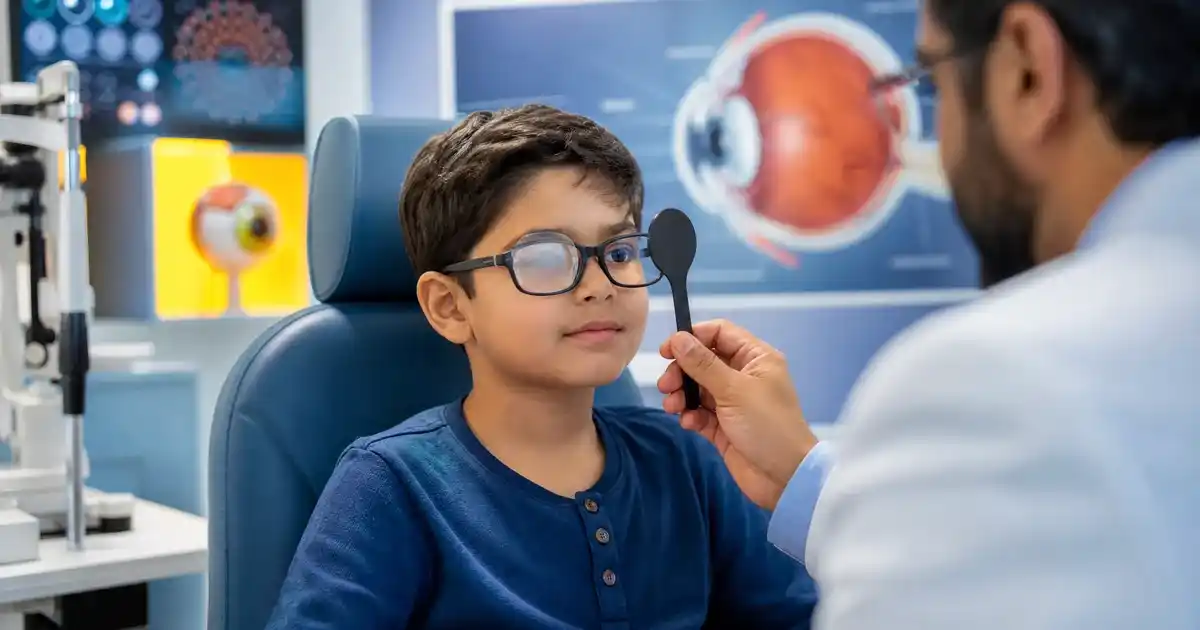
An eye examination for children is an essential part of assessing strabismus because reduced vision in one eye may change the treatment plan. The examination can include visual acuity testing, assessment of eye alignment and movements, and refraction when indicated.
Children may not realize that one eye sees less clearly than the other, which is why parents should not wait for a child to complain about poor vision before arranging an assessment when there are warning signs.
Treatment of Strabismus in Children Without Surgery
Several options may be used in treatment of strabismus in children without surgery, depending on the type and cause. Glasses may be prescribed to correct refractive errors, while patching may be used when amblyopia is present. Certain eye exercises may also be appropriate for selected types of strabismus.
It is important to distinguish between treating the eye deviation and treating amblyopia. Patching the stronger eye can help strengthen vision in the weaker eye, but it does not necessarily straighten the eye itself. Some children therefore require a combination of treatments.
Treatment of Strabismus Without Surgery
Treatment of strabismus without surgery may include glasses, patching, selected exercises, or regular monitoring. Glasses are particularly important when refractive error contributes to the deviation. If amblyopia is present, patching or other prescribed methods may be added to improve vision in the weaker eye.
Treatment should be individualized. Parents should follow the recommended patching schedule and should not change the duration or method without discussing it with the child's eye specialist.
Strabismus Treatment with Glasses
Strabismus treatment with glasses can be effective when the deviation is associated with refractive error, especially accommodative esotropia related to farsightedness. Correcting the focusing problem may reduce or improve the eye deviation in suitable cases.
Improvement with glasses does not mean that the child should stop wearing them without medical advice. The alignment may worsen if the underlying refractive problem is left uncorrected. Additional treatment may also be required when amblyopia is present.
Strabismus Treatment with Exercises
Strabismus treatment with exercises can be useful for selected forms of strabismus but is not a universal treatment. Certain exercises may improve convergence or binocular control in appropriate cases.
Parents should not start exercises based solely on online instructions. The child's ophthalmologist or orthoptist should determine whether exercises are appropriate, which exercises should be used, and how often they should be performed.
Strabismus Surgery for Children and When It Is Necessary
Strabismus surgery for children may be recommended when appropriate nonsurgical measures do not sufficiently correct the eye alignment or when surgery is expected to improve alignment and binocular function. The procedure changes the position or strength of selected eye muscles to improve how the eyes are aligned.
Surgery does not necessarily eliminate the need for glasses or amblyopia treatment. A child may still need glasses after surgery if a refractive error remains, and amblyopia treatment may continue according to the ophthalmologist's plan.
Strabismus Surgery for Children
Strabismus surgery for children involves adjusting one or more of the muscles responsible for eye movement. Depending on the type and degree of strabismus, the surgeon may operate on one or both eyes. In children, the procedure is commonly performed under general anesthesia, and many patients can return home the same day.
After surgery, temporary redness, watering, itching, discomfort, or a gritty sensation may occur. Some children may also experience temporary double vision. Follow-up examinations are important to assess healing and the stability of the eye alignment.
When Does a Child Need Strabismus Surgery?
The question of when a child needs strabismus surgery is answered after assessing the type of deviation, its severity, the child's visual development, and the response to nonsurgical treatment. Surgery may be considered when glasses and other appropriate treatments do not adequately improve alignment. It may also be used in selected cases to improve binocular function or an abnormal head posture related to strabismus.
There is no single age that is appropriate for every child. Timing depends on the specific type of strabismus and the child's visual development, so persistent or significant misalignment should be assessed rather than waiting for a particular age.
Risks of Strabismus Surgery
Like any operation, risks of strabismus surgery include possible complications, although the procedure is generally considered safe when appropriately indicated. Potential problems include residual or recurrent misalignment, the need for additional surgery, infection, muscle-related complications, and, rarely, more serious eye problems.
Temporary discomfort, redness, itching, or double vision may occur during recovery. Before surgery, the ophthalmologist should explain the expected benefits, possible risks, and follow-up requirements so that parents understand the treatment plan.
Follow-Up and Prevention of Strabismus Complications
Follow-up remains an important part of treatment of strabismus in children even after the eyes appear straighter. Some children continue to need glasses, amblyopia treatment, or periodic examinations to monitor vision and alignment. Surgical correction of eye position does not necessarily eliminate every visual problem associated with strabismus.
Regular follow-up allows the treatment plan to be adjusted as the child grows. It is especially important during the years when visual development is still taking place.
Complications of Strabismus in Children
Complications of strabismus in children may include reduced vision in the misaligned eye, amblyopia, and difficulties with binocular vision or depth perception in some cases.
Not every child will develop these problems, but persistent or recurrent strabismus should be evaluated. When amblyopia is present, treating it is an important part of care because the goal is to develop useful vision in the weaker eye, not simply to make the eyes look straight.
For more information, see Amblyopia in Children: Causes, Treatment, and the Importance of Early Diagnosis.
Importance of Follow-Up After Strabismus Treatment
The importance of follow-up after strabismus treatment lies in monitoring visual development, alignment, and the response to glasses, patching, exercises, or surgery. Children may require repeated examinations as they grow, particularly when amblyopia or refractive errors are present.
Parents should inform the doctor if the eye begins turning again, if new double vision develops, if the child's vision appears to change, or if the child is having difficulty following the prescribed treatment.
Improving Vision After Strabismus Treatment
Improving vision after strabismus treatment depends on the child's age, the type and cause of strabismus, the presence of amblyopia, and adherence to treatment. The goal may include improving vision in the weaker eye, achieving better eye alignment, and supporting the child's ability to use both eyes together.
Some children continue to need glasses after surgery, and amblyopia treatment may continue for a period of time. Therefore, treatment success should be assessed through both visual function and eye alignment rather than appearance alone.
Treatment Options for Strabismus in Children
Treatment option | When it may be used | Main goal |
|---|---|---|
Glasses | When a relevant refractive error is present | Improve focusing and potentially reduce the deviation |
Patching | When amblyopia affects one eye | Improve vision in the weaker eye |
Eye exercises | In selected types of strabismus | Improve control and binocular coordination |
Regular follow-up | According to the child's condition | Monitor vision and alignment |
Surgery | When appropriate nonsurgical treatment is insufficient or in selected cases | Improve eye alignment |
Conclusion
Treatment of Strabismus in Children: Nonsurgical and Surgical Options should be based on early diagnosis and an individualized plan that considers the child's age, the type and cause of strabismus, and vision in each eye. Glasses, patching, and selected exercises can be useful in appropriate cases, while strabismus surgery for children may be considered when nonsurgical treatment does not provide adequate alignment. Continued follow-up remains important even after successful treatment because the goal is not only straighter eyes but also the best possible visual development. Dr. Khalil Ibrahim Hijazi Consultant & Ophthalmic Surgeon can provide an individualized assessment to determine the cause of the deviation and the most appropriate treatment approach.
Frequently Asked Questions
Related Articles
Routine Eye Examinations for Children and Their Importance for Healthy Visual Development
Routine Eye Examinations for Children and Their Importance for Healthy Visual Development help detect vision problems early and support normal visual growth with specialized care from Dr. Khalil.
Persistent Tearing in Children: Causes and When Medical Care Is Needed
Persistent tearing in children may be caused by allergies, blocked tear ducts, inflammation, or eye surface problems. Early evaluation helps identify the cause and choose appropriate treatment.
Amblyopia in Children: Causes, Treatment, and the Importance of Early Diagnosis
Learn with Dr. Khalil Hijazi how amblyopia in children develops and why early diagnosis and appropriate treatment can help protect healthy visual development.
Signs of Strabismus in Children and When to See an Ophthalmologist
Discover with Dr. Khalil Hijazi the signs, causes, and treatment options for childhood strabismus and the importance of early diagnosis for healthy visual development.