
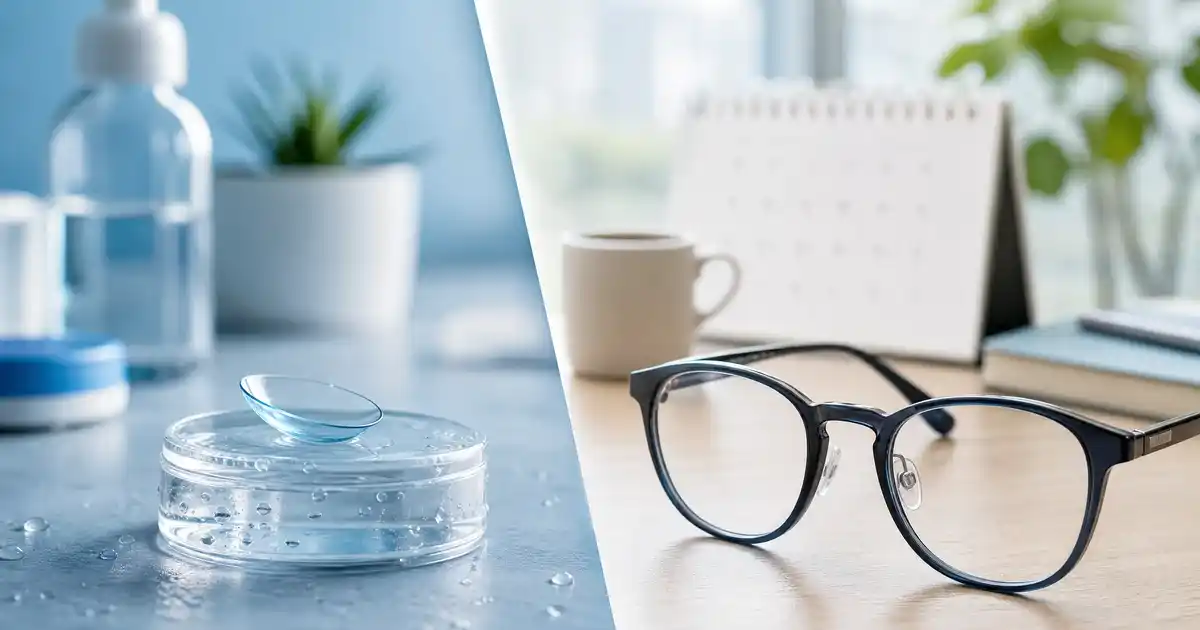
Contact Lenses or Prescription Glasses: Which Is Better for Daily Life?
Explore contact lenses and prescription glasses with Dr. Khalil to understand their differences and choose the option that best suits your daily visual needs.
People who need vision correction often ask whether contact lenses or glasses are the better choice for everyday life. There is no universal answer because the right option depends on visual prescription, eye health, daily activities, work requirements, and the ability to follow proper lens-care routines.
Contact lenses can provide a wide field of vision and greater freedom during certain activities, while glasses are simple to use and do not require direct contact with the eye. Each option has advantages and limitations that should be considered before making a decision.
At Dr. Khalil Ibrahim Hijazi Consultant & Ophthalmic Surgeon, patients receive an individualized assessment to help determine the most appropriate vision-correction option based on eye health, visual needs, comfort, and lifestyle.
Contact Lenses or Prescription Glasses: What Is the Difference?
The main difference between contact lenses and glasses is where the corrective lens is positioned. Glasses sit in front of the eyes, while contact lenses rest directly on the corneal surface.
Because contact lenses move with the eye, some users experience a more natural visual field, especially when looking sideways. Glasses, on the other hand, do not touch the eye and generally require less maintenance.
Difference Between Contact Lenses and Glasses
Prescription glasses correct the path of light before it enters the eye, while contact lenses correct vision directly on the corneal surface.
Contact lenses may provide a wider peripheral field of vision because they move with the eye. Glasses can be easier to put on and remove and do not require direct handling of the eye.
Comparison | Contact Lenses | Prescription Glasses |
|---|---|---|
Field of vision | Wide and follows eye movement | May be influenced by the frame |
Eye contact | Direct contact with the eye surface | No direct contact |
Daily care | Cleaning and proper storage required | Relatively simple cleaning |
Sports | Convenient for some activities | May be less practical for some sports |
Dry eye | May worsen symptoms in some users | Does not touch the eye |
Ease of use | Requires practice and care | Generally simple |
Cost | Depends on type and replacement schedule | Depends on frame and lenses |
Advantages of Contact Lenses
One of the main advantages of contact lenses is that they provide a wide field of vision without a frame in front of the face.
They can be useful for people who participate in sports or activities where glasses may be inconvenient. They may also appeal to people who prefer not to wear glasses continuously.
However, contact lenses are not automatically suitable for everyone. The lens design, fit, and material should be selected according to the individual's eye condition.
Advantages of Prescription Glasses
Prescription glasses are easy to use and do not require the user to touch the eye when putting them on or taking them off.
They can also provide an additional physical barrier against environmental factors such as dust and wind. Different lens features can be selected according to visual needs.
Glasses are also a practical choice for children and people who may find contact-lens care difficult to maintain consistently.
Advantages and Disadvantages of Contact Lenses
Contact lenses can be an excellent vision-correction option when used properly, but they require careful hygiene and adherence to professional instructions.
Medical Contact Lenses
Medical contact lenses are designed to correct specific refractive errors rather than simply serving a cosmetic purpose.
Different types may be used for myopia, hyperopia, astigmatism, or certain presbyopia-related needs. The appropriate design depends on the individual's prescription, corneal shape, and ocular surface.
Contact lenses should not be selected solely according to convenience. Proper fitting and professional evaluation are important for safe use.
Disadvantages of Contact Lenses
One disadvantage of contact lenses is that they require more maintenance than glasses. Depending on the lens type, users may need cleaning, appropriate storage, and scheduled replacement.
Some users may experience dryness or discomfort, particularly after prolonged wear or in dry, air-conditioned environments.
Some people also need time to learn how to insert and remove lenses comfortably.
Potential Harm From Contact Lenses
Problems can occur when contact lenses are used incorrectly, such as sleeping in lenses that are not designed for overnight wear, exceeding the recommended replacement period, or handling lenses with unclean hands.
Improper use can contribute to irritation, inflammation, and potentially more serious corneal infections.
Users should follow professional instructions and stop wearing lenses if significant redness, pain, discharge, or sudden visual changes develop.
Advantages and Disadvantages of Prescription Glasses
Prescription glasses remain one of the most widely used forms of vision correction because they are practical, flexible, and relatively simple to maintain.
Prescription Glasses
Prescription glasses can correct refractive errors such as myopia, hyperopia, and astigmatism according to an accurate eye examination.
Different frame and lens designs can be selected to suit work, study, driving, and daily activities.
Glasses may be particularly appropriate for people with dry eyes or those who prefer not to place a corrective device directly on the eye.
Advantages of Prescription Glasses
Glasses are easy to wear and remove and do not require direct contact with the eye.
They can be used continuously and can incorporate different lens features according to individual needs, such as anti-reflective coatings or UV protection.
They are also a practical choice for children and people who prefer a simple vision-correction routine.
Disadvantages of Prescription Glasses
Some users may dislike the appearance of frames or experience a limited peripheral field depending on the frame and lens design.
Glasses can also fog, become scratched, or be less convenient during certain sports and physical activities.
Nevertheless, many of these limitations can be reduced by selecting an appropriate frame and lens design.
Which Is Better for Daily Life?
There is no single option that is best for everyone. The decision depends on eye health, lifestyle, daily activities, and the user's ability to follow the required care routine.
Are Contact Lenses Better Than Glasses?
Whether contact lenses are better than glasses depends on the individual.
Contact lenses may be more convenient for someone who exercises regularly or wants a wider visual field. Glasses may be preferable for someone with dry eyes or someone who values simplicity.
Some people can also use both options, choosing glasses for certain situations and contact lenses for others.
Choosing Contact Lenses
Choosing contact lenses requires consideration of prescription strength, corneal shape, ocular surface health, dryness, sensitivity, and daily wearing habits.
The lens material, design, and replacement schedule should be selected appropriately. A lens that works well for occasional wear may not be ideal for prolonged daily use.
Proper hygiene and adherence to the recommended wearing schedule remain essential.
Best Way to Correct Vision
The best way to correct vision is different for each person. Glasses or contact lenses may be appropriate, while some patients may eventually qualify for other vision-correction procedures after a detailed eye evaluation.
The decision depends on refractive error, corneal health, ocular surface condition, age, lifestyle, and individual expectations.
A complete eye examination and accurate prescription are therefore important before choosing a correction method.
How Do You Choose the Right Vision-Correction Method?
Choosing a vision-correction method should be both a medical and practical decision. The goal is not only clear vision but also long-term comfort and eye safety.
Contact Lenses for Daily Activities
Contact lenses may be particularly convenient for activities involving movement, sports, or situations where a wide field of vision is useful.
They can also be preferred for social events or activities where users do not want to wear glasses. However, wearing time, environmental conditions, and ocular surface health should be considered.
If redness, pain, or significant discomfort develops, lenses should be removed and the eye assessed rather than continuing to wear them.
Prescription Glasses for Everyday Use
Prescription glasses are a practical everyday option, especially for people who prefer simple correction without direct contact with the eye.
They can be used for work, studying, driving, and many other daily activities. Different lens and frame options can be selected according to individual requirements.
Regular vision checks are recommended when noticeable changes in vision occur.
Factors Affecting the Choice of Vision Correction
Several factors can influence the decision:
Type and degree of refractive error.
Corneal and ocular surface health.
Dry eye or sensitivity.
Work and study requirements.
Sports and outdoor activities.
Ability to maintain contact-lens hygiene.
Age and daily needs.
Personal comfort and preferences.
For some people, the most practical solution may be using both glasses and contact lenses at different times.
Conclusion
The comparison between contact lenses and prescription glasses is not about choosing one universally superior option. It is about identifying which method best matches the individual's eye health, lifestyle, visual needs, and ability to maintain safe use.
Contact lenses can provide freedom and a broad field of vision, while glasses offer simplicity, easy maintenance, and no direct contact with the ocular surface.
At Dr. Khalil, patients can receive an individualized eye assessment to help determine the most suitable correction method according to their prescription and daily requirements.
A well-informed choice can support clearer vision, better comfort, and healthier long-term eye care.
Frequently Asked Questions
Related Articles
Astigmatism: Causes, Symptoms, and the Best Vision Correction Options
Astigmatism can cause blurred vision, eye strain, and headaches. Dr. Khalil explains its causes, severity, diagnosis, and suitable vision correction options.
The Difference Between Myopia and Hyperopia and How to Choose the Right Treatment
Discover with Dr. Khalil Hijazi the difference between myopia and hyperopia, their correction options, and the factors that determine the right treatment.
Retinal Tear: How Is It Diagnosed and Treated Before Vision Loss?
A retinal tear may cause sudden floaters or flashes and requires timely diagnosis and appropriate treatment before it progresses to retinal detachment and vision loss.
Treatment of Strabismus in Children: Nonsurgical and Surgical Options
This article explains Treatment of Strabismus in Children: Nonsurgical and Surgical Options, including its causes, symptoms, diagnosis, glasses, exercises, patching, surgery, and follow-up.