Smart Lens Implantation or LASIK: Which Is More Suitable for Your Case?
Discover with Dr. Khalil Hijazi how smart lens implantation and LASIK differ, and how precise eye assessment helps identify the right vision correction option.
Choosing the right vision correction procedure has become an important decision for people who want to reduce their dependence on glasses or contact lenses. With the development of modern refractive surgery, patients can now consider several options, including smart lens implantation and LASIK surgery. However, the most advanced procedure is not necessarily the best choice for every patient.
The decision depends on several medical factors, including corneal thickness and shape, the degree of myopia or hyperopia, age, stability of the prescription, and the overall health of the eye. A detailed eye examination is therefore essential before selecting any procedure.
At Dr. Khalil Ibrahim Hijazi Consultant & Ophthalmic Surgeon, each case is assessed individually to determine the most appropriate treatment option. The goal is not simply to achieve vision correction without glasses, but to select a safe and suitable procedure that supports good visual quality and long-term eye health.
Smart Lens Implantation and LASIK for Vision Correction
Modern vision correction procedures aim to improve the eye's ability to focus light properly on the retina. Smart lens implantation and LASIK are among the available options for patients seeking to reduce their dependence on traditional glasses and contact lenses.
Neither procedure is universally suitable for everyone. The appropriate choice depends on the patient's refractive error, corneal characteristics, age, eye health, and visual requirements. A comprehensive examination provides the foundation for making this decision safely.
Smart Lens Implantation for Correcting Vision Problems
Smart lens implantation involves placing an artificial lens inside the eye to help correct refractive errors and improve the way light is focused. Vision correction lens implantation may be considered for patients who are not ideal candidates for corneal laser procedures.
The appropriate lens type depends on several factors, including age, refractive error, eye anatomy, and daily visual needs. For this reason, the lens should not be selected based only on another patient's experience. Precise measurements and a comprehensive examination are essential before determining whether this option is appropriate.
LASIK Surgery and the Advantages of Vision Correction
LASIK surgery uses laser technology to precisely reshape the cornea and correct the way light enters the eye. One of the main advantages of LASIK is that it corrects refractive errors without placing an artificial lens inside the eye.
Suitable patients may experience relatively rapid visual recovery. However, LASIK is not appropriate for everyone. Corneal thickness, corneal shape, refractive stability, the degree of vision impairment, and general eye health must all be assessed before surgery.
Modern Refractive Surgery Procedures
Modern refractive surgery includes several techniques. Some procedures reshape the cornea, while others involve placing a lens inside the eye. The most suitable approach depends on the patient's individual medical characteristics.
There is therefore no single procedure that can be considered the best for every patient. The purpose of the preoperative assessment is to identify the option that provides appropriate vision correction while maintaining eye safety and reducing potential complications.
The Difference Between LASIK and Smart Lens Implantation
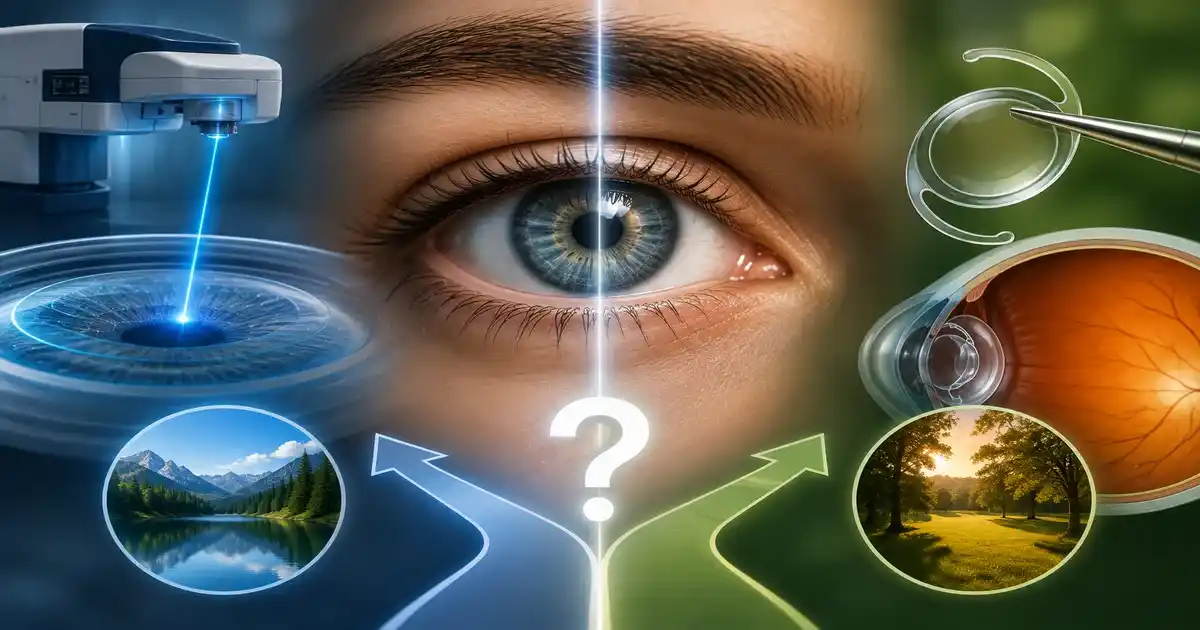
The main difference between LASIK and lens implantation lies in how the refractive error is corrected. LASIK reshapes the cornea using a laser, whereas smart lens implantation uses an artificial lens placed inside the eye to help correct the focus of incoming light.
When comparing the two procedures, ophthalmologists consider factors such as the degree of myopia or hyperopia, corneal thickness and shape, age, prescription stability, and overall eye health.
LASIK or Smart Lenses: Which Is Better?
There is no universal answer to whether LASIK or smart lenses are better. The most suitable procedure varies from one patient to another. LASIK may be appropriate for a patient with a healthy cornea, adequate corneal thickness, and stable vision, while lens implantation may be more suitable in selected cases.
The decision should be based on a balanced assessment of expected benefits, possible risks, and long-term visual needs. The patient's lifestyle and expectations should also be considered so that the final decision is medically appropriate rather than based only on the desire to stop wearing glasses.
Advantages of LASIK Compared with Lens Implantation
One of the main advantages of LASIK is that it corrects the refractive error by reshaping the cornea without inserting an artificial lens into the eye. Appropriate patients may also experience relatively fast improvement in vision.
However, comparing laser correction with lens implantation should not focus only on recovery speed. Corneal safety, refractive error, ocular surface health, expected visual quality, and the possibility of future changes in vision are more important considerations when selecting a procedure.
Potential Disadvantages of Smart Lens Implantation
Like any intraocular surgical procedure, smart lens implantation may involve potential risks. These can vary according to the type of lens, the patient's eye condition, and the specific surgical technique.
For this reason, the potential disadvantages of smart lens implantation should be considered alongside its expected benefits. Accurate measurements, appropriate lens selection, and proper postoperative follow-up can contribute to reducing risks and supporting a stable visual outcome.
Comparison | Phakic / Implantable Lens Surgery | LASIK |
|---|---|---|
Treatment Method | An implantable lens is placed inside the eye to correct refractive errors | A laser reshapes the cornea |
High Refractive Errors | May be suitable for some patients with higher prescriptions | Suitable within certain limits depending on corneal thickness and refractive error |
Corneal Thickness | Does not rely on removing corneal tissue in the same way | Corneal thickness and shape must be evaluated before treatment |
Dry Eye | May be an option for some patients where dry eye is an important consideration, depending on medical assessment | Temporary dry eye may occur in some patients after surgery |
Age and Prescription Stability | Lens selection depends on age, eye health, and the patient's expectations | Usually considered after the prescription has stabilized |
Lens Removal | Some implanted lenses can be removed or exchanged if necessary | There is no implanted lens to remove because the cornea is reshaped |
Recovery Period | Varies according to the lens type, procedure, and eye condition | Functional vision often improves within a short period, although recovery varies |
Who May Be More Suitable? | May suit some patients who are not LASIK candidates or who have higher refractive errors | May suit patients with healthy corneas, stable prescriptions, and suitable measurements |
Choosing the Treatment | Requires a comprehensive eye examination and detailed lens and corneal measurements | Requires assessment of the cornea, refractive error, and overall eye health |
Choosing the Best Vision Correction Procedure According to Your Condition
Choosing the best vision correction procedure should not depend on the refractive prescription alone. A comprehensive assessment of the eye is necessary to determine whether LASIK, smart lens implantation, or another option is more suitable.
At Dr. Khalil Eye Center, the patient's cornea, refractive error, age, eye health, and visual expectations are considered before developing an individualized treatment plan. This approach helps ensure that the selected procedure is based on medical suitability rather than a one-size-fits-all recommendation.
LASIK Requirements for Suitable Patients
LASIK requirements vary according to each patient's circumstances, but stable vision and a healthy cornea are among the most important factors. Corneal thickness and shape must also be suitable for laser correction.
The examination may also assess dry eye, corneal abnormalities, inflammation, or other eye conditions that could affect the safety or outcome of the procedure. Therefore, eligibility for LASIK cannot be determined solely by the patient's prescription.
Vision Correction Lens Implantation for Special Cases
Vision correction lens implantation may be considered for certain patients who are not ideal candidates for corneal laser procedures. The decision may depend on the degree of refractive error, corneal characteristics, age, and overall eye health.
There are different types of smart lenses for the eye, with different optical designs and indications. The appropriate lens is selected according to detailed measurements and the patient's visual requirements rather than simply choosing a particular lens type based on popularity.
Best Treatment for Myopia and Hyperopia
There is no single best treatment for myopia and hyperopia that applies to every patient. Glasses or contact lenses may remain the most appropriate choice for some people, while selected patients may benefit from refractive surgery after meeting the necessary medical criteria.
When surgery is considered, the available options are compared according to corneal condition, refractive error, age, and eye health. This individualized approach makes it possible to select treatment based on the patient's actual needs.
The Cost of Vision Correction Procedures and Influencing Factors
The cost of smart lens implantation and the cost of LASIK can vary considerably between cases. Factors may include the technology used, the patient's refractive error, preoperative examinations, the type of lens required, and the follow-up plan.
Cost should therefore not be evaluated separately from the quality of diagnosis and medical care. The suitability of the procedure, the experience of the surgical team, the safety of the technique, and the quality of postoperative monitoring are all important parts of the overall treatment decision.
Cost of Smart Lens Implantation
The cost of smart lens implantation may depend on the type of lens, required examinations, the complexity of the case, the surgical procedure, and postoperative follow-up.
A single general cost cannot accurately represent every patient because medical needs differ. The first step is determining whether lens implantation is appropriate and identifying which lens type best matches the patient's eye measurements and visual needs.
Cost of LASIK and Factors Affecting the Price
The cost of LASIK may be influenced by the technology used, the degree of refractive error, the examinations required before surgery, and the postoperative follow-up plan.
Two patients with similar prescriptions may still have different medical requirements. Therefore, the cost should be considered as part of the complete treatment plan rather than as an isolated factor.
Types of Smart Lenses for the Eye and Their Costs
Different types of smart lenses for the eye have different designs, optical characteristics, and clinical applications. The appropriate lens is selected according to the patient's age, refractive error, eye measurements, and visual expectations.
The cost can also vary according to the lens type and the associated examinations and surgical requirements. Medical suitability should therefore remain the primary factor when selecting a lens.
Long-Term Results of Smart Lens Implantation and LASIK
The results of refractive surgery depend on several factors, including appropriate patient selection, accurate measurements, the chosen technology, eye health, and adherence to postoperative instructions.
Suitable patients may achieve a significant reduction in their dependence on glasses. However, outcomes vary from person to person. Natural age-related changes in the eye may also affect vision in the future, making regular eye examinations important even after successful treatment.
Vision Correction Without Glasses Using Modern Technologies
Many patients seek vision correction without glasses, and modern technologies can help suitable candidates reduce their dependence on corrective eyewear. LASIK or smart lens implantation may provide this benefit depending on the patient's individual condition.
However, achieving good unaided vision does not necessarily mean that glasses will never be needed again. Some patients may require reading glasses later in life because of natural age-related changes in near vision.
Comparing the Results of Vision Correction Procedures
A proper comparison of vision correction results should consider visual clarity, stability of vision, recovery, eye safety, and the potential need for additional treatment in the future.
A previous patient's experience cannot accurately predict another patient's result because corneal characteristics, refractive error, and eye health differ. A comprehensive examination is therefore essential for establishing realistic expectations.
Choosing the Right Technology for Eye Health
Choosing the appropriate technology begins with a complete assessment of eye health rather than simply measuring visual acuity. The cornea, lens, retina, eye pressure, and refractive measurements may all be evaluated before treatment.
This process helps the patient understand the difference between LASIK and smart lens implantation and make a more informed decision. At Dr. Khalil Eye Center, accurate diagnosis, individualized treatment selection, and continued medical follow-up remain central to the care plan.
Conclusion
The choice between smart lens implantation and LASIK is a highly individualized medical decision. Neither option can be considered universally superior because the appropriate procedure depends on corneal condition, age, refractive stability, degree of vision impairment, general eye health, and the patient's visual needs.
Modern refractive procedures can provide suitable patients with significant improvement in vision and reduce dependence on glasses or contact lenses. However, successful treatment begins with accurate diagnosis, appropriate patient selection, careful surgical planning, and regular follow-up.
At Dr. Khalil Ibrahim Hijazi Consultant & Ophthalmic Surgeon, every case is evaluated individually to understand the patient's needs and determine the most appropriate vision correction approach. The priority remains eye safety, visual quality, and long-term care.
A specialized evaluation can provide a clearer path toward the vision correction option that best matches your eyes and daily visual needs.
Frequently Asked Questions
Related Articles
Femto LASIK Vision Correction: Benefits and Procedure Steps
Femto LASIK Vision Correction: Benefits and Procedure Steps explains candidacy, benefits, treatment stages and recovery with Dr. Khalil Ibrahim Hijazi.
How to Prepare for LASIK and Follow Post-Surgery Instructions
Learn with Dr. Khalil about LASIK preparation, essential examinations, postoperative eye care, recovery, and the safe return to daily activities.
Laser Vision Correction in Istanbul: Who Is Suitable and What Results Can Be Expected?
Discover with Dr. Khalil Hijazi the available laser vision correction in Istanbul, who may benefit from them, and how accurate testing supports the right technique and realistic visual expectations.
Retinal Tear: How Is It Diagnosed and Treated Before Vision Loss?
A retinal tear may cause sudden floaters or flashes and requires timely diagnosis and appropriate treatment before it progresses to retinal detachment and vision loss.