Femto LASIK Vision Correction: Benefits and Procedure Steps
Femto LASIK Vision Correction: Benefits and Procedure Steps explains candidacy, benefits, treatment stages and recovery with Dr. Khalil Ibrahim Hijazi.
Refractive errors such as myopia, hyperopia, and astigmatism can affect daily activities and often lead patients to rely on glasses or contact lenses. Modern laser vision correction techniques have introduced more precise ways to reshape the cornea, and femtosecond-assisted LASIK is one of the established options for appropriately selected patients.
Femto LASIK uses a femtosecond laser to create the corneal flap, followed by an excimer laser treatment that reshapes the cornea according to the patient’s individual measurements. However, the procedure is not suitable for everyone. Corneal thickness and shape, refractive stability, ocular surface health, and general eye health must all be evaluated before treatment.
At Dr. Khalil Ibrahim Hijazi Consultant & Ophthalmic Surgeon, each patient can undergo an individualized assessment designed to identify the most appropriate vision correction option and establish realistic expectations.
What Is Femto LASIK and How Does It Work?
Femto LASIK is a form of LASIK in which a femtosecond laser creates the corneal flap instead of a traditional mechanical microkeratome. After the flap is created, an excimer laser removes microscopic amounts of corneal tissue to reshape the cornea and correct the refractive error.
The technique allows the surgeon to plan several flap parameters with high precision. Modern ophthalmic references indicate that femtosecond flap creation provides more predictable and uniform flap characteristics and has reduced several flap-related complications associated with mechanical techniques.
Femto LASIK
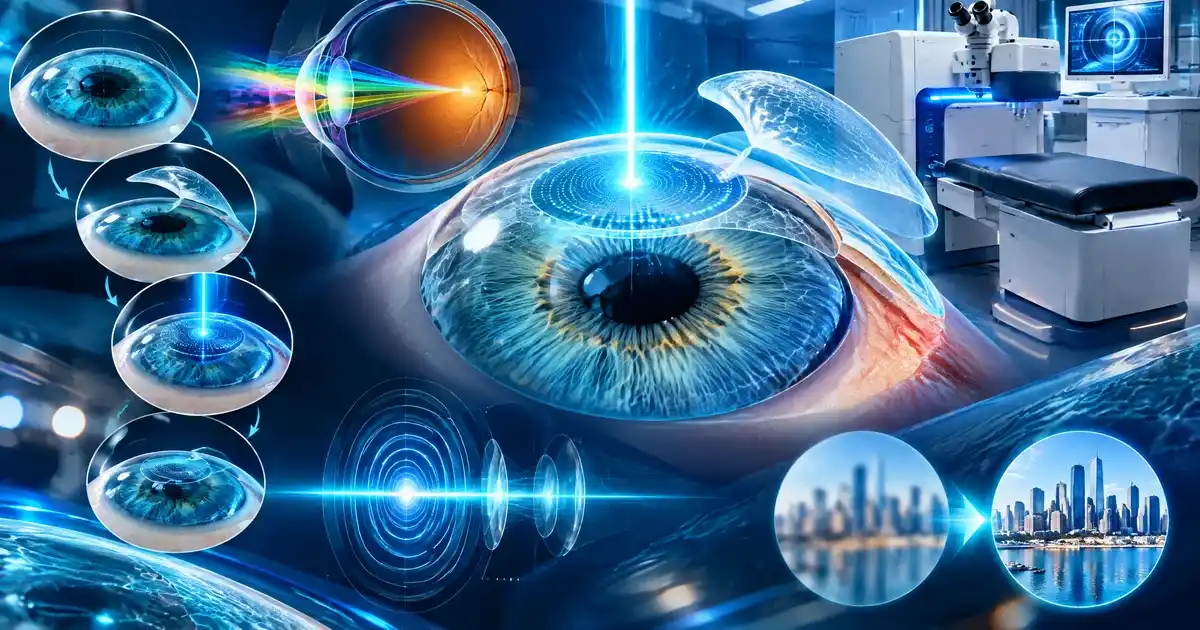
During Femto LASIK, the femtosecond laser delivers extremely rapid pulses at a predetermined depth inside the cornea. These pulses create a precise separation plane, allowing the surgeon to lift the corneal flap and access the underlying stromal tissue.
The excimer laser then reshapes the cornea according to the treatment plan. Once the laser correction is complete, the flap is carefully repositioned. No routine sutures are generally required because the corneal flap naturally adheres to the underlying tissue.
Femto LASIK Vision Correction
Femto LASIK Vision Correction aims to change the refractive power of the cornea so that incoming light can focus more accurately on the retina. It may be considered for selected cases of myopia, astigmatism, and some forms of hyperopia.
Before treatment, the ophthalmologist evaluates visual acuity, refraction, corneal shape and thickness, ocular surface condition, and other relevant factors. Patients who wear contact lenses may need to discontinue them before certain measurements because lenses can temporarily alter corneal shape.
Femto LASIK for the Eyes
Femto LASIK for the eyes should never be recommended solely on the basis of the glasses prescription. A patient with the same prescription as another person may have a different corneal structure or ocular surface condition and therefore require a different approach.
Understanding candidacy is particularly important for patients considering laser correction for the first time. More information about Laser Vision Correction in Istanbul: Who Is Suitable and What Results Can Be Expected? can help explain the factors involved in selecting an appropriate laser procedure.
Benefits of Femto LASIK for Vision Correction
One of the main advantages of Femto LASIK is the combination of femtosecond laser flap creation with excimer laser corneal reshaping. The approach provides detailed control over flap parameters and allows the treatment plan to be tailored to the patient’s refractive measurements.
Nevertheless, the benefits of the technology cannot be separated from patient selection and preoperative assessment. A technically advanced procedure cannot compensate for an unsuitable cornea or untreated ocular surface disease.
Benefits of Femto LASIK
Benefits of Femto LASIK may include highly predictable flap creation, precise control of flap depth and diameter, and reduced rates of certain mechanical flap complications compared with older microkeratome techniques.
Many suitable patients experience substantial reduction in their dependence on glasses or contact lenses. Early visual recovery can also be relatively rapid, although the exact recovery pattern differs between individuals.
Patients should understand that these benefits describe potential outcomes rather than a guarantee of perfect vision. The final result depends on the refractive error, corneal characteristics, treatment planning, healing response, and adherence to postoperative instructions.
Femto LASIK Results
Femto LASIK Results vary from patient to patient. Some patients achieve excellent unaided visual acuity, while others may still require glasses for particular situations, especially reading as age-related changes develop.
Vision may fluctuate during the early postoperative period. Glare, halos, dry eye symptoms, or changes in night vision can occur while the eyes stabilize. Medical guidance indicates that visual stabilization may continue for several months in some patients.
Laser Vision Correction
Laser Vision Correction includes several procedures, and the most suitable option depends on the patient’s corneal structure, refractive error, ocular surface, and individual circumstances. Femto LASIK is one option rather than a universal solution.
A comprehensive assessment may identify situations in which another laser technique or a lens-based procedure is more appropriate. Patients interested in understanding lens alternatives can read Smart Lens Implantation or LASIK: Which Is More Suitable for Your Case?
Factor | Femto LASIK |
|---|---|
Flap creation | Femtosecond laser |
Corneal reshaping | Excimer laser |
Main purpose | Correction of refractive errors |
Preoperative assessment | Refraction, corneal evaluation and ocular surface assessment |
Early recovery | Usually relatively rapid |
Follow-up | Essential for monitoring healing and visual stability |
Steps of Femto LASIK Surgery
Femto LASIK involves several stages, beginning with a detailed eye examination and treatment planning. The surgical stage is only one part of the process; accurate measurements and appropriate patient selection are equally important for safety and predictable results.
Before surgery, patients may receive specific instructions concerning contact lenses, medications, cosmetics, and eye hygiene. After surgery, follow-up visits help the ophthalmologist monitor healing, visual acuity, and any symptoms that may require additional management.
Steps of Femto LASIK
The Steps of Femto LASIK generally begin with comprehensive measurements of refraction and corneal characteristics. Once candidacy has been confirmed, topical anesthetic drops are used to numb the eye.
The femtosecond laser then creates the corneal flap according to the preprogrammed treatment parameters. The surgeon lifts the flap and applies the excimer laser treatment to reshape the corneal tissue. The flap is then carefully repositioned and allowed to adhere naturally.
Femto LASIK Procedure
The Femto LASIK Procedure is generally performed using topical anesthesia. Patients may feel pressure or mild discomfort during some stages, but significant pain is not expected during the laser treatment itself.
Temporary burning, tearing, foreign-body sensation, light sensitivity, or blurred vision may occur immediately afterward. Patients should avoid rubbing their eyes because mechanical pressure can affect the corneal flap. Prescribed eye drops and protective measures are an important part of early postoperative care.
Patients can also review How to Prepare for LASIK and Follow Post-Surgery Instructions to understand practical preparation and aftercare considerations.
Vision Correction Surgery
Successful Vision Correction Surgery begins with appropriate patient selection. The ophthalmologist reviews the refractive prescription, evaluates the cornea, assesses the ocular surface, and identifies any medical or eye conditions that could affect healing.
Following treatment, patients should follow instructions concerning eye drops, eye protection, exercise, water exposure, cosmetics, and follow-up appointments. Severe pain or worsening vision should not be considered a normal part of recovery and requires prompt medical assessment.
Femto LASIK Requirements and Main Side Effects
Femto LASIK candidacy depends on multiple clinical factors. Stable refraction, appropriate corneal anatomy, good ocular health, and realistic expectations are among the important considerations.
Patients should discuss their complete medical and ophthalmic history with the surgeon, including previous eye surgery, medications, dry eye symptoms, and any condition that may interfere with healing. A thorough evaluation helps determine whether Femto LASIK is appropriate or whether an alternative should be considered.
Femto LASIK Requirements
Femto LASIK Requirements commonly include adulthood according to the applicable laser indication, stable refraction, healthy corneal anatomy, and the absence of active eye disease that could compromise the procedure.
A changing glasses prescription, significant ocular surface disease, certain corneal abnormalities, or medical conditions affecting healing may require postponement or an alternative treatment. The exact requirements should be determined through an individualized examination rather than through prescription strength alone.
Femto LASIK Side Effects
Possible Femto LASIK Side Effects include temporary dry eye, fluctuating vision, glare, halos, light sensitivity, and difficulty with night vision. Most postoperative symptoms improve with time, but some can persist for longer periods in certain patients.
Less common complications can involve the corneal flap, inflammation, infection, epithelial changes, or other visual disturbances. Contemporary ophthalmic literature confirms that serious complications are uncommon, but no refractive surgery is completely risk-free.
Disadvantages of Femto LASIK
Potential Disadvantages of Femto LASIK include the possibility of residual refractive error, continued dependence on glasses for certain activities, dry eye symptoms, or visual disturbances such as glare and halos.
Another limitation is that not every patient is anatomically suitable. The decision should therefore be based on safety and individual eye characteristics rather than on the desire to eliminate glasses alone. Patients should understand both benefits and limitations before providing informed consent.
Recovery After Femto LASIK and Surgical Results
Recovery after Femto LASIK often begins quickly, but early improvement should not be confused with complete visual stabilization. Vision may fluctuate during the first weeks, while dry eye symptoms and light sensitivity can gradually improve.
Postoperative care includes prescribed medications and lubricating drops when indicated, avoiding eye rubbing, protecting the eyes during sleep during the early period, and attending scheduled examinations.
Recovery Time After Femto LASIK
The Recovery Time After Femto LASIK varies between patients. Many people can resume routine activities relatively quickly, but the eyes may continue to change during the first several weeks.
Medical guidance indicates that vision may take approximately three to six months to stabilize in some patients. Activities such as swimming, contact sports, and the use of eye cosmetics may need to be restricted temporarily according to the surgeon’s instructions.
Femto LASIK Results
Femto LASIK Results depend on accurate measurements, suitable patient selection, treatment planning, healing response, and postoperative care. The goal is to achieve the best safe visual outcome possible rather than to promise an identical result for every patient.
Even after successful refractive correction, age-related changes such as presbyopia can eventually affect near vision. Regular eye examinations therefore remain important after surgery.
Difference Between LASIK and Femto LASIK
The Difference Between LASIK and Femto LASIK mainly concerns how the corneal flap is created. Traditional LASIK may use a mechanical microkeratome, whereas Femto LASIK uses a femtosecond laser to create the flap.
In both approaches, an excimer laser is generally used to reshape the cornea. Femtosecond technology provides more predictable flap dimensions and has reduced several flap-related complications associated with mechanical techniques.
Patients may also benefit from learning about alternatives to refractive surgery through Contact Lenses or Prescription Glasses: Which Is Better for Daily Life?, as well as understanding the underlying refractive error through The Difference Between Myopia and Hyperopia and How to Choose the Right Treatment and Astigmatism: Causes, Symptoms, and the Best Vision Correction Options.
Conclusion
Femto LASIK Vision Correction: Benefits and Procedure Steps represents an advanced option for correcting selected refractive errors. Its advantages include precise femtosecond flap creation and individualized corneal reshaping, while proper screening remains essential for reducing risks and achieving a predictable outcome.
At Dr. Khalil Ibrahim Hijazi Consultant & Ophthalmic Surgeon, treatment planning is based on a detailed evaluation of the patient’s eyes, visual goals, and suitability for laser correction. Appropriate follow-up also helps monitor healing and identify any unusual symptoms early.
For patients considering laser vision correction, an individualized assessment at Dr. Khalil can provide a clearer understanding of the available options and the factors relevant to their eyes.
Frequently Asked Questions
Related Articles
How to Prepare for LASIK and Follow Post-Surgery Instructions
Learn with Dr. Khalil about LASIK preparation, essential examinations, postoperative eye care, recovery, and the safe return to daily activities.
Smart Lens Implantation or LASIK: Which Is More Suitable for Your Case?
Discover with Dr. Khalil Hijazi how smart lens implantation and LASIK differ, and how precise eye assessment helps identify the right vision correction option.
Laser Vision Correction in Istanbul: Who Is Suitable and What Results Can Be Expected?
Discover with Dr. Khalil Hijazi the available laser vision correction in Istanbul, who may benefit from them, and how accurate testing supports the right technique and realistic visual expectations.
Chronic Dry Eye: Causes, Treatment, and the Best Ways to Prevent It
Chronic dry eye can affect comfort and visual quality. Understanding its causes, treatment options, and prevention strategies can support healthier eyes with Dr. Khalil.